← Back to Blog
Reality ChecksBeginners
Reality Check: Nose Pinch
Pinch your nose shut and try to breathe in through it. In a dream, you can. Here's how to do one of the most reliable reality checks properly and make it part of your day.
Published October 29, 2026·5 min read
TL;DR
Pinch your nose, close your mouth and try to breathe in through your nose. If air gets through, you're dreaming
Ludream rates the reliability of this check at five out of five stars, a rating only critical reflection shares. The result is unambiguous: either you get air or you don't
The usual explanation: your body in bed keeps breathing freely, and only your dream hand is pinching your nose
Do the check 10 to 20 times a day, each time genuinely asking yourself whether you're dreaming
In studies, reality checks alone did not measurably increase lucid dreams. That's why the check belongs in a routine with a technique such as MILD
A reality check is a quick test you use to find out whether you're dreaming. If you do one in a dream and notice that something is off, the chances rise that you become lucid, meaning aware that you're dreaming.
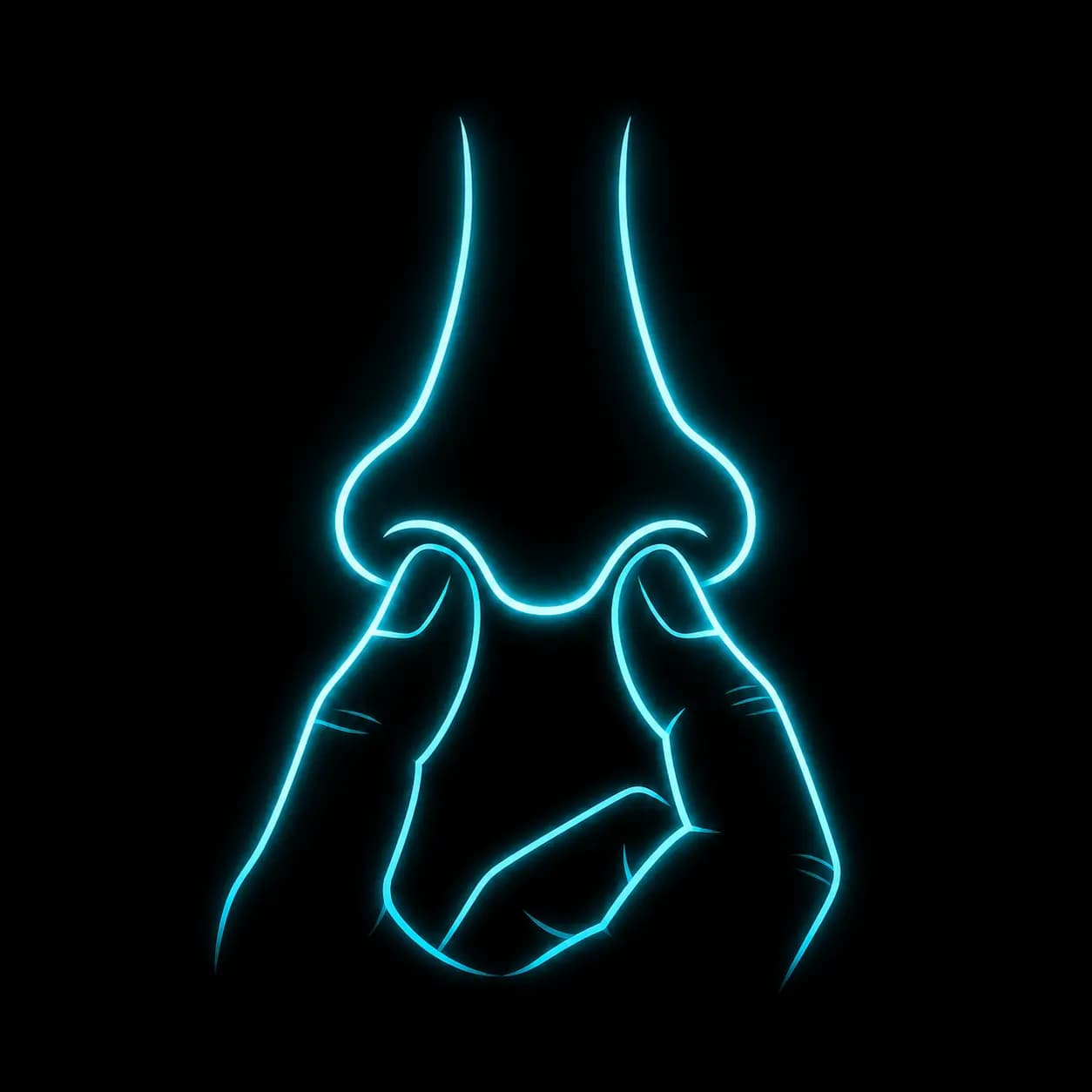
For the nose pinch, you hold your nose shut and try to breathe in through it. Awake, no air gets through, of course. In a dream, you keep breathing normally even with your nose pinched, and that contradiction tells you you're dreaming.
This article covers how to do the check properly, why it works in a dream, and how often to practice it.
How to Do the Check
- Pause for a moment and seriously ask yourself: “Am I dreaming right now?”
- Pinch your nostrils together with your thumb and index finger until no air can get through.
- Close your mouth.
- Calmly try to breathe in through your nose. Two or three attempts are enough.
- Pay close attention to what happens. If no air gets through, you're awake. If air flows through your pinched nose, you're dreaming.
- Then look around and ask yourself whether anything about your surroundings seems strange.
The first step matters most. If you go into the check already expecting to be awake, you carry that expectation into your dreams, where it makes it easy to overlook that you're breathing through a pinched nose.
Make sure to close your mouth. With your mouth open, you may keep breathing through it without noticing, and the check tells you nothing.
Why You Can Breathe Through a Pinched Nose in a Dream
During REM sleep, the sleep stage with the most vivid dreams, almost all of your muscles are paralyzed. This REM atonia stops your sleeping body from acting out what you do in the dream. The exceptions are the eye muscles and the diaphragm. So your breathing carries on all night, through a nose that nobody is pinching.
In the dream, only your dream hand is holding your nose shut. The usual explanation goes like this: the sensation of breathing in a dream follows your actual breathing in bed, and that is unobstructed. So you feel air even though you're pinching your nose in the dream.
The explanation is plausible, and many lucid dreamers report exactly this experience.
How Reliable Is the Check?
In the Ludream app, the nose pinch has a reliability rating of five out of five stars. The only other check with that rating is critical reflection.
The check's biggest advantage is that its result is unambiguous. With other reality checks based on text, numbers or your hands, you look for something that seems different from usual. In a dream, though, text, numbers and hands can look normal or only slightly changed, and then you have to decide for yourself whether that change already points to a dream. With the nose pinch, there are only two possibilities: you get air or you don't. You also don't need a clock, a piece of text or a mirror for it, since you have your nose with you in every dream.
Despite its five stars, this check can fail in a dream too. Dreams often follow what you expect. If you are firmly convinced in the dream that no air will come through your pinched nose, the dream can produce exactly that: your nose stays blocked, and you take yourself to be awake. Some practitioners report precisely this. If you're unsure, do the check a second time and also ask yourself how you got to this place. If you can't remember, that's a strong sign you're dreaming.
What Research Shows About Reality Checks
Reality checks work through habit. What you do often and attentively during the day, you eventually do in your dreams as well, and there the check gives you a result that can't be right.
Aspy, Delfabbro, Proeve and Mohr (2017) studied how much reality checks achieve in an Australian study with 169 participants. Those who did only reality checks for a week did not have measurably more lucid dreams afterward. The group that combined reality checks with a short wake period during the night (WBTB) and the MILD technique did: lucid dreams on 17.4% of nights instead of 9.4%.
A follow-up study (Aspy, 2020) examined how much the reality checks contributed to that increase. People who did reality checks during the day on top of MILD and WBTB did not have measurably more lucid dreams after a week than the group without checks. One of the variants tested was a breathing check similar to the nose pinch. The author explicitly limits this result to that short period of one week.
So the core of your routine is a technique such as MILD. Reality checks complement it during the day, and a dream journal captures what you dreamed each morning.
How Often and When to Do the Check
Ludream recommends 10 to 20 checks a day. More important than the number is doing each one attentively. A check done in passing while you're thinking about something else achieves little, because you would do it just as absent-mindedly in a dream.
Good moments for the check:
- when something seems strange or unexpected
- when you enter a new room or place
- right after waking up, because sometimes you're only dreaming that you've woken up. This is called a false awakening
Fixed times are easy to forget, and a reminder that always arrives at the same time is one you'll swipe away without thinking after a few days. Reminders at random times, on the other hand, catch you in all kinds of different situations.


Allow several weeks before the check shows up in a dream for the first time. Write down your dreams so you don't miss that moment. How to do that best is covered in Improving Dream Recall.
Frequently Asked Questions
Do I have to close my mouth during the check?
Yes. With your mouth open, you may be breathing through it without noticing, and the result tells you nothing. Close your mouth and deliberately try to breathe in through your nose.
What if I can't get any air in the dream?
Then your dream has taken on your expectation. That happens with every reality check now and then. Do the check again and also ask yourself how you got to this place.
Can anything happen if I pinch my nose in a dream?
No. Your body in bed keeps breathing freely, whatever your dream hand is doing. When you're awake, too, a breathing attempt of a few seconds is enough.
Will people notice if I do the check in public?
Hardly. You can briefly take your nose between your thumb and index finger as if you were scratching it. A single calm attempt to breathe in is enough.
How long does it take before I do the check in a dream?
There's no study data on this, and it varies from person to person. Expect several weeks of daily practice. A dream journal shows you when the check appears in a dream for the first time.
Conclusion
Pinch your nose, close your mouth, breathe in: the check takes a few seconds and gives you a clear answer. For it to show up in your dreams, do it often during the day, each time seriously asking yourself whether you're dreaming.
Together with a technique such as MILD and a dream journal, it's a good way to get started with lucid dreaming.
This article is for informational purposes. Consult a sleep specialist if you have a sleep disorder.
← Back to Blog